SEASON 11 | SOUNDING PICTURES
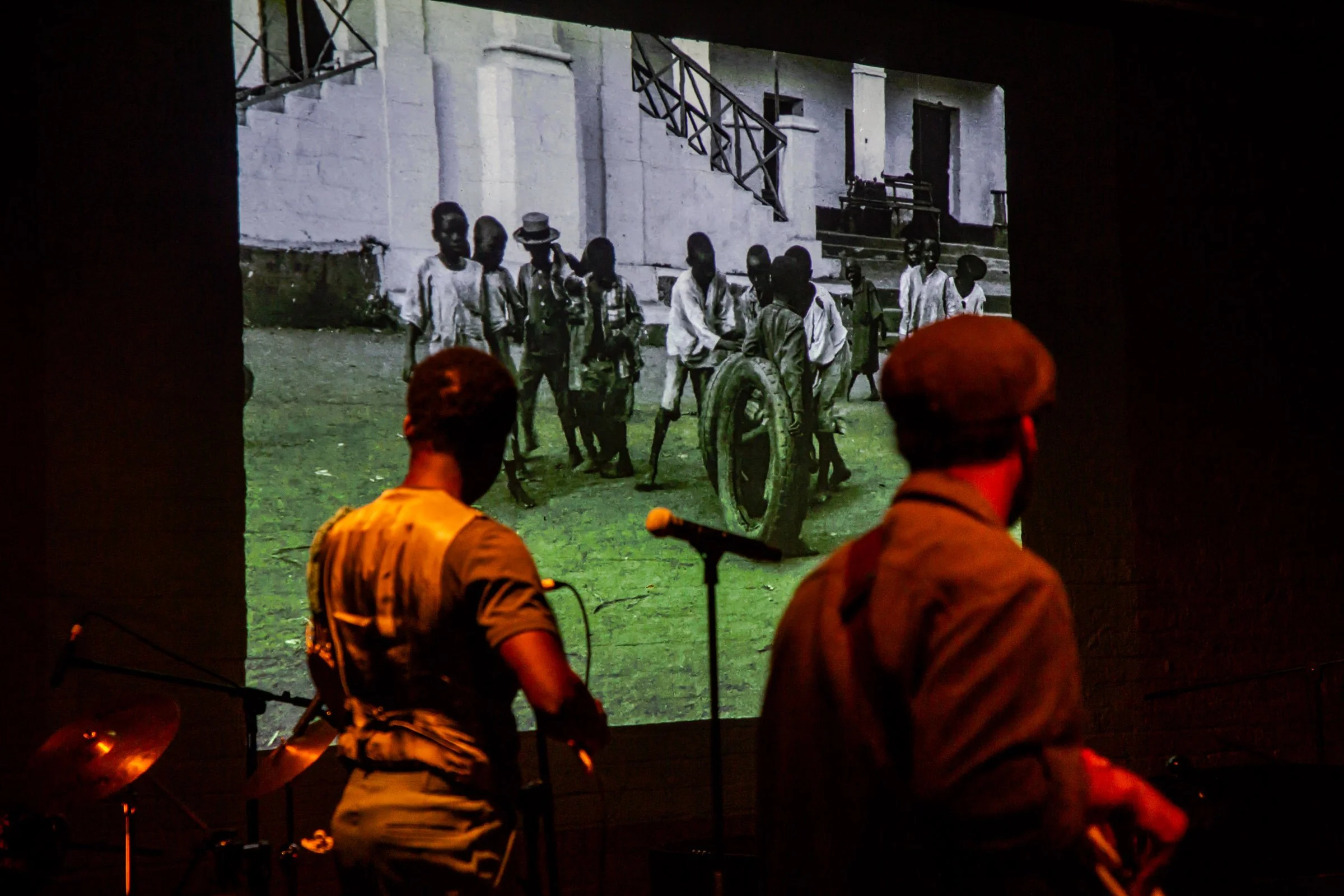
Angelo Moustapha (left) and Shane Cooper (right) responding to a silent film as part of the Sounding Pictures programme. Photographer | Bash Hops
Sounding Pictures: Live Scores to Short Silent Films, asks the question: what happens when we look at a silent film collectively and collaboratively, responding with live, improvisational sound, performance and text, and how does this influence the narrative of the film?
“The opportunity is to watch a certain film with two or three different scores, and subsequently with two or three different narratives or interpretations,” says Muyanga. “We might discover a difference in the narrative of the film, and we’re trying to figure out what happens in that gap between intention and interpretation.”
In Sounding Pictures, a series of contemporary, short silent films (between 3 - 15 minutes) became the provocation for musicians who, in many instances, encountered them for the first time, in front of a live audience. Muyanga explains that this is a process that requires deep listening on the part of the artists.
“They have to be listening deeply and responsively to what the visuals are suggesting as a narrative. They have to be creative, and collaborative, and they have to, in a sense, work telepathically with one another to create a live score.”
This allows for a live, collaborative score to be produced, and for a methodology of deep, collaborative listening to emerge, where the commitment to the other sounds and impulses in the room became the most crucial part of the process.
O QUICKLY DISAPPEARING PHOTOGRAPH
A work-in-progress film towards a commission by Lucerne Symphony Orchestra, O Quickly Disappearing Photograph is a film by William Kentridge, scored live by pianist Jill Richards.
Pages of the artist’s notebook turn, fold, and explode, filtering through different colours, figures and forms – a man walking across the page, a turning tree, processional landscapes. All the while, Richards’ score is fittingly discordant and varied – low and restrained at times, then pitchy and precarious to suit the moving image.
We trace a meandering red line across the pages, and the music carves a similar path through the film. The room watches and listens together, making similar associations and connections halfway between image and sound, co-authoring the narrative of the film, and drawing independent conclusions.
CREDITS
FILMMAKER | William Kentridge
EDITOR | Žana Marović
MUSICIAN | Jill Richards
A work-in-progress towards a commission by Lucerne Symphony Orchestra
FROM ZERO: JOHANNESBURG
One of Season 11’s guest artists, documentary filmmaker Frank Scheffer presents a new work for interpretation as part of the Sounding Pictures programme.
Scheffer is best-known for his experimental documentary films on artists, musicians, and composers – including John Cage, Gustav Mahler, Marina Abromović, and Philip Glass – and this short film is a collection of scenes from a selection of his films over the years, cut together and screened for the first time as part of Sounding Pictures.
On screen, eyes open and close, clouds form and dissipate, there are explosions and openings, great visual epiphanies and new beginnings. The pacing of the film becomes interesting, lending it to a frenetic and disjointed response. On screen, they tell us one thing. Paired with an improvisational score, they begin to tell us another.
The musical ensemble watches and responds, collectively, creating lush, burgeoning soundscapes and melancholic stillness. The film ends on a declarative and sombre note – a woman violinist playing over Tehran.
CREDITS
FILMMAKER | Frank Scheffer
TEXT | Andreas Fiedler
MUSICIANS | Micca Manganye, Shane Cooper, Daniel Stompie Selibe, Reggie Teys & Pertunia Msani
ECSTATIC EXIT
A forest, a monument. A body in crisis, a death. As we watch these cinematic scenes filter by, the music in the room swells and dissipates, growing quieter, more frenetic, or more percussive as each scene passes.
This is Hallie Haller’s Ecstatic Exit, a short film offered up for collective ways of seeing and responding as part of the Sounding Pictures programme. Adding to the live music are the two orators in the room, Billy Langa and Namatshego Khutsoane, who read out fragments of found text borrowed from local poetry, short stories and playscripts.
The result is an incidental collage of language, sound and moving image where new associations can spark, and a different kind of reading of Haller’s film is discovered.
CREDITS
FILMMAKER | Hallie Haller
MUSICIANS | Micca Manganye, Shane Cooper, Daniel Stompie Selibe, Reggie Teys & Pertunia Msani
ORATORS | Billy Langa & Namatshego Khutsoane
WEIGH YOUR HEART AGAINST A FEATHER
Filmed and edited by Noah Cohen, Weigh Your Heart Against a Feather shows Johannesburg through a series of quotidian and quietly compelling vignettes.
There are the ubiquitous suburbs by night, the city at rush hour, deep blue pools and the greening canopies of Jacaranda trees. In the room, working between the music and alongside the moving image, are the orators who give us a series of narrative suggestions in the form of incidental aphorisms. There is also the music – a creeping, lilting, screeching refrain, but also a buoyancy, a lightness, a joy. Associations spark and multiply.
Much like Johannesburg, the film and its resultant score are restless, unsettled, always on the precipice of change or reinvention. There is room for interpretation, reinterpretation, co-authoring, and mutual reliance. We find its narrative together.
CREDITS
FILMMAKER | Noah Cohen
MUSICIANS | Micca Manganye, Shane Cooper, Daniel Stompie Selibe, Reggie Teys & Pertunia Msani
ORATORS | Billy Langa & Namatshego Khutsoane
FEATURED INSTALLATION FOOTAGE | Lamis Haggag & Mina Nasr
DEAF REPUBLIC
Something of an outlier when it comes to the Sounding Pictures format, Deaf Republic is an original film by William Kentridge, with a pre-composed score by musician and artist Reggie Teys.
Rather than Teys responding and improvising to the moving image in real-time, this performance allows for a considered engagement with the film, which showcases Kentridge’s signature charcoal-drawn, text-based and stop-motion animated films.
The result is a resolved and compelling accompaniment with a beautiful, lilting, almost romantic pace.
CREDITS
FILMMAKER | William Kentridge
EDITOR | Joshua Trappler
MUSICIAN | Reggie Teys
OBSCURE WHITE MESSENGER
“Can you remember what happened?”
“I don’t remember what happened. But yes, I did stab him right through.”
Obscure White Messenger is perhaps one of the best-known video works by the South African painter and filmmaker Penny Siopis. In it, Siopis makes use of home-movie footage from the 1950s and 1960s overlaid with interview transcripts to focus on the life and inner world of Dimitrios Tsafendas, the man who assassinated South African Prime Minister Hendrik Verwoerd – the architect of apartheid – in 1966.
Meeting this collage-like and dream-like visual narrative are a pair of musicians and pair of orators who, eyes trained on the film playing out in front of a live audience, are tasked with responding to it, musically, linguistically, and improvisationally. The result is a rich reading of a layered and complex work, that allows for audiences to be invited or perhaps lulled into a new narrative, as well as be struck by the incidental moments – erratic drumbeats underscoring home-footage of a child running along a beach, for example.
But there is also a deepening of the work that emerges through this process of live interpretation. The orators are at times relatable, other times deliberately not, as they interpret, echoe, re-localise and fictionalise in multiple langauges, the interview transcripts we read on screen. Ultimately, a new work emerges — a collaborative re-reading of history and of narrative process by Siopis, performers, and audience members alike.
CREDITS
FILMMAKER | Penny Siopis
MUSICIANS | Daniel Stompie Selibe & Micca Manganye
ORATORS | Billy Langa & Namatshego Khutsoane
IBILE
Angelo Moustapha’s Ibile is stark and confrontational, which is perhaps to say that the footage used in the film carries the tone and style of how it was made – an anthropological point of inquiry where staged dances, rituals, and ways of life have all been performed for the camera.
So, it’s this act of collectively seeing and responding through music and performance that allows for a way of re-reading the footage with a softness, an empathy, a playfullness that is able to liberate it from its rigour, and its flat rendering of complex life.
As composer, Moustapha leads and the musicians – percussionist Micca Manganye, vocalist Pertunia Msani, and double bassist Shane Cooper – follow and collaborate. It is an experimental score, and an enjoyable performance, but discordance has a function here, too. Strategically used, it becomes a way of unsettling a gaze, or troubling a neat way of seeing. What is it that we’re looking at? Who are these people – these austere nuns, these young women displaying their garments and hairstyles. Who is doing the looking? And how to create a sonic response that doesn’t co-sign or reinforce a particular narrative, but co-authors a new one instead?
The moments of fidelity between sound and picture are satisfying – a drum sounding out when we see a drum being struck on screen, for example. But these moments always require disruption. This is where new meaning is generated, when old narratives become unsettled or corrupted in interesting ways.
CREDITS
COMPOSER | Angelo Moustapha
MUSICIANS | Angelo Moustapha, Pertunia Msani, Micca Manganye & Shane Cooper
EDITOR | Simon Moirot
FILM CREDIT | Collection Archives de la Planète, Musée départemental Albert-Kahn, Département des Hauts-de-Seine
All text by David Mann