SEASON 11 | MOVING THE MARK
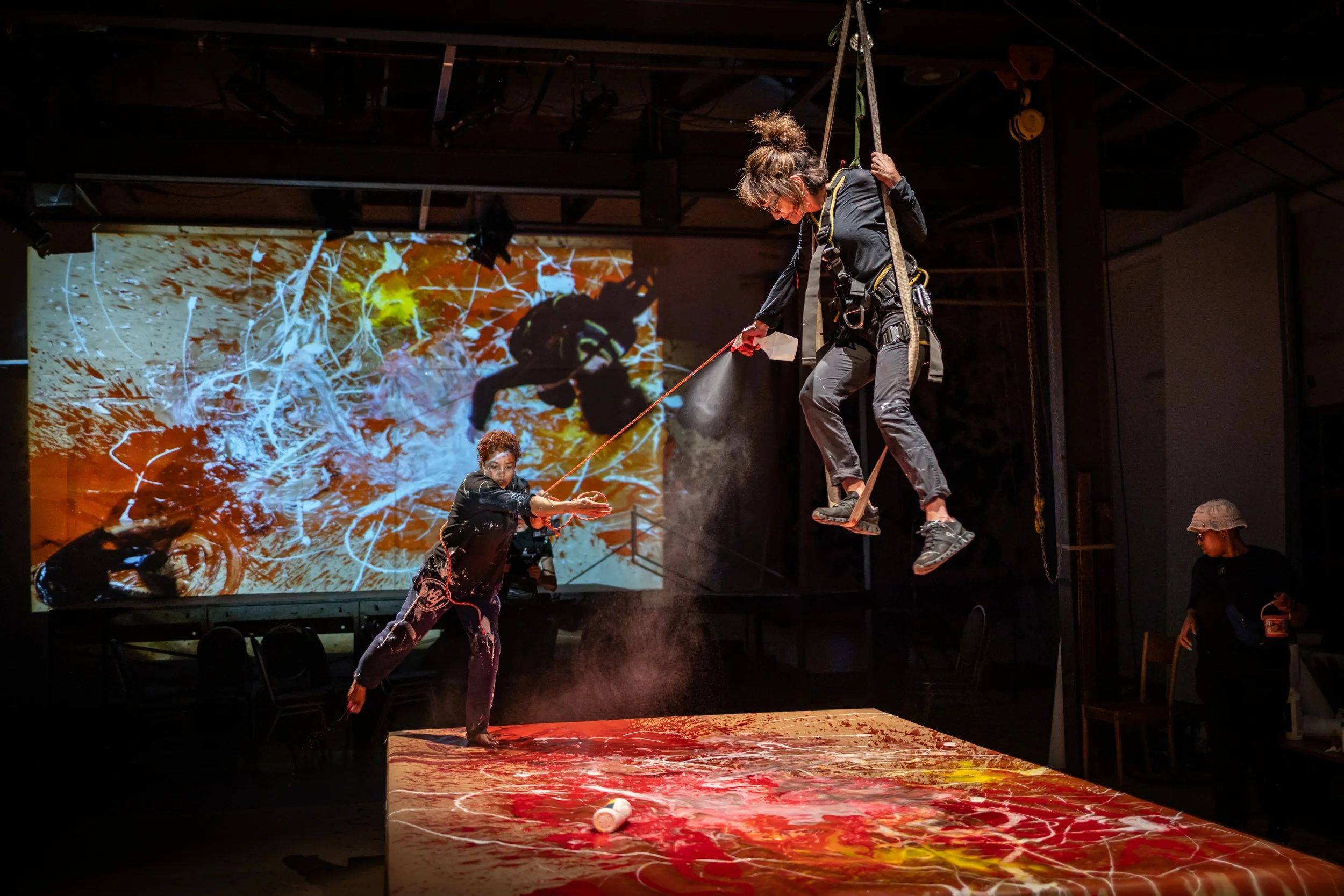
Shanell Winlock-Pailman (left) and Penny Siopis (right) in ‘The Harness and the Canvas’. Photographer | Zivanai Matangi
A new programme at The Centre, Moving the Mark pairs prominent visual artists and dancers towards a series of responsive, interdisciplinary experiments in movement and mark-making.
Here, the interest is in what might be discovered as a result of this pairing, but also what’s revealed in the act of collaboration – what new methodologies or creative decisions emerge when a dancer mimics an ink stain, or a painter choreographs their brushstrokes?
SCROLL
Across the length of the stage, two dancers stand on either sides of a scroll of blank, white paper, slowly unfurling it. Vincent Mantsoe approaches the scroll and begins to notate, in charcoal, a burgeoning score.
A soundtrack emerges from off stage – live, rhythmic percussion and double bass. Buoyed by the energy of this new composition, Mantsoe adjusts his pace, quickens his gesture, and begins to populate the moving scroll through an increasingly frenetic choreography. The musicians respond in kind, rising in volume and pace. There is tremendous energy between them.
Soon, it’s unclear whether Mantsoe is dictating or responding to the score, as mark, movement, and music collapse into a single moment. The paper becomes saturated, mirroring manic drums and strings as Mantsoe drops the charcoal and begins notating with his bare hands.
All the while, the two dancers continue to move the scroll, slowly, certainly, revealing a palimpsestic musical and material object – as much a collection of abstract, intuitive marks, as it is an embodied score.
CREDITS
PERFORMERS | Vincent Mantsoe, Thulisile Binda & Smangaliso Ngwenya
MUSICIANS | Shane Cooper, Micca Manganye & Neo Muyanga
PERCUSSIVE FOOTPRINTS
At the centre of the room, a low stage covered in paper is illuminated. The percussionist Micca Manganye enters, crouches down beside a bowl of black paint, and begins to tap out a simple rhythm.
Each beat leaves a material trace, and each handprint becomes a musical notation. As the stage-turned-canvas is covered in these performative marks, the dancer Vincent Mantsoe joins, and the work becomes a duet. The crowd joins in, lending momentum to a growing chant and percussive refrain.
Together, the two artists multiply the energy, filling the canvas with music, gesture, and remarkable energy, all captured in the smear and splatter of black paint. It ends on a single, resounding note, and an empty stage bearing the material traces of collaborative physicality and musicality.
CREDITS
PERFORMERS | Micca Manganye & Vincent Mantsoe
BROOM
William Kentridge appears on stage, dips a grass broom into a tray of black paint, and begins. The crowd, seated around the stage, watches the artist in front of them, as well as on the wall at the back of the room, where a top down view of the stage is projected.
A line emerges and grows into an ampersand. There is music, too, responding to Kentridge’s gestures. He dips the oversized brush once again, and brings it back down, sending paint splatters across the stage. As he continues, the top-down view of the canvas reveals an increasingly abstract stage, filled with thick, black swathes of paint. Kentridge moves across the stage, tracking paint across the paper with his bare feet.
The crowd is under a happy spell. This is the joy of watching a mark being put to paper, a gesture finding form, and leaving a material trace. There is a certain logic to the evolving image and soundscape, a happenstance that emerges through movement, mark, and music.
Then, like magic, the mark comes undone, the gestures are reversed. On screen, and on the stage, we see Kentridge moving backwards, retracing his footsteps, his marks. We see the black swathes disappear, the splatters dissolve, the ampersand reveal itself once more, until there is nothing but an empty stage. Kentridge sets his brush down, and takes a bow.
CREDITS
ARTIST | William Kentridge
MUSICIANS | Micca Manganye & Daniel Stompie Selibe
VIDEO EDITOR | Joshua Trappler
THE HARNESS & THE CANVAS
The artist Penny Sipois is suspended above the stage by a pulley and a rope, carrying a bucket full of water and ink. Guided by the dancer Shanell Winlock-Pailman, she is pulled into position, swaying precariously above the crowd. She pauses, lifts the bucket, and tosses – Splash! – covering the stage in colour.
So begins a performance full of risk, mess, spillage, collaborative energy and colour. As Winlock-Pailman pulls Siopis across the stage, the artist continues to work, populating her horizontal canvas from above, throwing ink, cold glue, water and more onto the stage. An image forms below her, similarly projected for the audience on a wall at the back of the room, deepening and evolving the artist’s visual field.
Almost as soon as the duo has established a rhythm and a logic to their performance, they disrupt it. Winlock-Pailman steps onto the stage, slipping and sliding through the clotted mixture of paint and glue. Here, there is a divine transference of power and authorship – where Siopis, originally, in a position of great precarity, becomes the anchor for Winlock-Pailman as she navigates this visual field.
Similarly, there is Winlock-Pailman’s shift from choreographer to mark-maker, as she moves across the stage, intervening in and remaking Siopis’ composition.
Eventually, Winlock-Pailman leaves the stage, and Siopis is brought down from her harness. What remains is a trace of this collaborative, performative encounter – a canvas full of improvised movement, form, slippage and collaborative composition.
CREDITS
ARTIST | Penny Siopis
PERFORMER | Shanell Winlock-Pailman
MUSICIANS | Micca Manganye & Daniel Stompie Selibe
DRAWING & RESPONDING
An empty screen is projected above a raised stage towards the back of the room, where the dancer Vincent Mantsoe stands, waiting. On the other side of the room, William Kentridge stands at his drawing table. A large hand holding a piece of charcoal enters the frame, and begins to draw. Music emerges, and Mantsoe leaps into action.
A collaborative performance between Kentridge and Mantsoe, Drawing & Responding is an improvised investigation into the relationship between the drawn mark and the body in motion. Accompanying Kentridge’s gestures is the percussive work of Micca Manganye on a typewriter, and that of double bassist Shane Cooper. Together, the four artists drive the pace, rhythm, and composition of the work.
As Kentridge’s hand flashes across the screen, carrying a thick, arcing line with it, Mantsoe dips, turns and falls to his knees, responding to both the mark-making on screen behind him, and his own physical impulses. Similarly, Kentridge draws around, alongside, and in unison with Mantsoe’s movement.
They reach a crescendo, yielding an explosive landscape, torn up, wiped clean, and rearranged. The music dies down, and Manstoe comes to a rest, as Kentridge places the stick of charcoal down on his drawing table.
CREDITS
ARTIST | William Kentridge
PERFORMER | Vincent Mantsoe
MUSICIANS | Shane Cooper & Micca Manganye
PUZZLE
Tall columns of cardboard bearing abstract lines and shapes populate the back wall of the studio. As the music rises, the pattern breaks and shifts, moving across the stage.
Choreographed in real-time by Vincent Mantsoe, Puzzle is a short, experimental performance that sees artists and dancers bringing a canvas to life. Here, the question becomes: What happens when a mark is choreographed by a dancer, performed by an artist, and composed in real-time?
The result is a short-form work of playful and engaging performance, where the stage becomes the canvas, and the body serves as the mark.
CREDITS
CHOREOGRAPHER | Vincent Mantsoe
PERFORMERS | Smangaliso Ngwenya, Thulisile Binda, William Kentridge & Bronwyn Lace
MUSICIANS | Shane Cooper, Micca Manganye, Angelo Moustapha & Daniel Stompie Selibe
STRUCTURE
In front of an empty wall lined with brown paper, a wire structure is suspended above the stage. From it, the dancer Kitty Phetla emerges, moving slowly, almost meditatively, in a bucket filled with paint, and in time with the rhythmic percussion of Daniel Stompie Selibe.
Soon, she is joined by the artist Nandipha Mntambo, who kneels before Phetla and covers the dancer’s legs in paint. Artist and dancer engage in their respective practices – Phetla moving in poetic, balletic gestures, and Mntambo slowly covering the stage and the wall in red and black paint.
Structure, devised by Mntambo and Phetla, is a work of repetition and ritual, mediated through painting and performance. Together, the two go about making their mark on stage – Mntambo using a brush, Phetla with her paint-covered feet – and subsequently craft a narrative of genuflection, reverence, and collaboration.
CREDITS
ARTIST | Nandipha Mntambo
PERFORMER | Kitty Phetla
MUSICIAN | Daniel Stompie Selibe
CANVAS DUET
Canvas Duet, as its name suggests, is a work that sees two artists from two different disciplines, converging on stage and canvas.
It begins with a floating, lilting canvas, moving across the stage as if floating. The artist Penny Siopis stands and watches on. Eventually, the canvas drops to the floor, and the dancer Shanell Winlock-Pailman emerges. The two take a moment to consider the canvas before working into it with paint, ink, water, gesture and movement – a dance between people, practices, and ways of seeing.
Directed by Athena Mazarakis, Canvas Duet is a work about searching on the most fundamentally human level. It’s a conversation that gets swallowed and abstracted through the canvas, and then, in moments of pause, surfaces, allowing the two to meet each other again.
At its core, Canvas Duet is about the act of looking for and conversing with oneself through the other, through mark-making and performance.
CREDITS
ARTIST | Penny Siopis
PERFORMER | Shanell Winlock-Pailman
MUSICIANS | Micca Manganye & Daniel Stompie Selibe
DIRECTOR | Athena Mazarakis
THE MIRROR
A woman sits at a vanity with her back to the audience. She is considering herself, applying makeup and fixing her hair. Suddenly, she emerges again, from just off stage, dressed in the same flowing red dress, moving just as slowly, and scattering leaves around her.
In The Mirror, we see the same character on two different paths, two different states. The one, concerned with her appearance, with self-preservation, with rest, and the other performing a choreography of refusal.
Conceptualised by Mary Sibande and performed by Pertunia Msani and Sibande, with live music by Angelo Moustapha, Micca Manganye and Daniel Stompie Selibe, this is a performance of resistance against the burdens of femininity, against hegemonic patriarchal norms, and against the everyday unseen labour of women at home, in the workplace, and in the world more broadly.
As Msani sits at her vanity, she sings, – a crooning lament – providing a responsive soundscape for Sibande who, armed with a grass broom, swipes at the fallen leaves, leaving lashings of paint across the walls and floors. It is a work of great energy and frustration, but also freedom and liberation. Here, each swipe of the broom is a letting, a release, over and over again, punctuated always by percussion and the sharp wails of Msani.
They go on until they cannot anymore, leaving nothing but a stage full of scattered, blackened leaves, and a grass broom.
CREDITS
ARTIST | Mary Sibande
PERFORMER | Pertunia Msani
MUSICIANS | Angelo Moustapha, Micca Manganye & Daniel Stompie Selibe
All text by David Mann