THE MASKANDALIFICATION OF OPERA | EIGHT SHORT-FORM, EXPERIMENTAL OPERAS
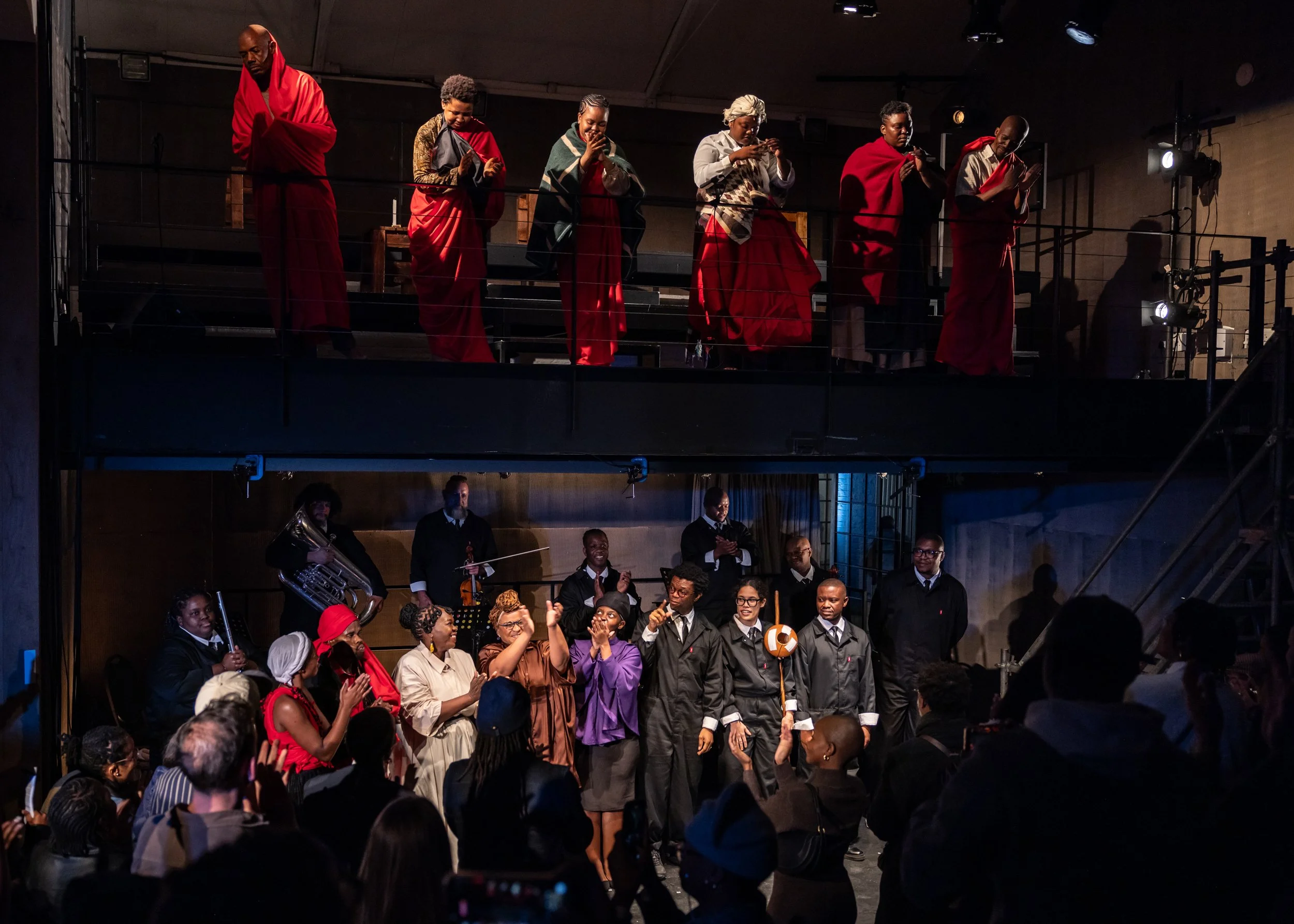
Eight new miniature operas by South African composers have been created. These composers presented their scores and concepts to an ensemble of musicians, singers and dramaturges, who brought the dramatic musical stories to life over the course of this three-day mini festival. Watch them all below.
EURIDICE
It begins with the chorus upstairs, a melodic division of space — above and below, heaven and hell, history and futurity. Below them, a luminous portrait of Euridice, the first of many projected drawings and landscapes in motion by William Kentridge. Euridice herself — played by Thuli Magubane — enters and performs the libretto, written by poet Ingrid de Kok and overlaying Kentridge’s drawings.
For The Maskandalification of Opera, Euridice becomes a feminist retelling of the story of Euridice, which views her as not just the late wife of the musician, Orfeo, but as a woman who relishes in the independence and solitude she finds in the Underworld.
“Here I am no-one’s bride” she sings from below, an ephemeral figure dancing alongside her, backed by the orchestra concealed behind the veil. We leave her in a lighter state, somehow liberated and untethered. After the Rainer Maria Rilke poem ‘Orpheus, Eurydice, Hermes’: “She was inside herself, like a great hope, and never thought of the man who walked ahead.”
CREDITS
LIBRETTIST | Ingrid De Kok
VISUAL ARTIST | William Kentridge
MUSICIANS | Mapule Moloi, Nokuthula Magubane, Vhahangwele Moopo, Thokozani Dubazane, Sizwe Nkosi, Bongile Lecoge-Zulu, Larissa Johnson, Kabelo Motlhomi, Justin Sasman, Micca Manganye, Waldo Alexander, Tiisetso Mashishi, Phumelelo Ndlovu & Daliwonga Tshangela
VIDEO EDITOR | Žana Marović
DRAMATURG | Kabi Thulo
CHOREOGRAPHERS | Smangaliso Ngwenya & Thuli Binda
DANKIE BHOZA
Johannesburg, city of labour. Here, the streets facilitate the daily commute to and from work, while also being sites of labour themselves. Between the busy taxi routes, and rattling train lines, the city and its winding concrete arteries are the office of the everyday worker.
Conceptualised by Vusi Mdoyi, Dankie Bhoza looks at the reality of being a Pantsula, with a focus on how amaPantsula survive as cultural activists and entertainment entrepreneurs alike, through their ‘many offices’ of self-employment. Beginning on the scaffolding merging orchestra pit and the singers’ gallery, Mdoyi is the everyman, hustling at the robots, selling his wares, beating out a rhythm on an empty beer crate, a chorus of commuters narrating his daily hustle.
But it’s not all work and no play. There is love in this experimental opera — a conversation between flute and feet is a declaration of unrequited love without language. Like his search for work, he is not deterred. Quite the opposite. Rather, it is the pantsula’s impulse to “bloom where all flowers die.”
CREDITS
COMPOSER | Vusi Mdoyi
MUSICIANS | Mapule Moloi, Nokuthula Magubane, Vhahangwele Moopo, Thokozani Dubazane, Sizwe Nkosi, Mandisa Yende, Lufezo Bovungana, Kabelo Motlhomi, Justin Sasman, Bongile Lecoge-Zulu, Larissa Johnson, Micca Manganye, Phumelelo Ndlovu, Waldo Alexander, Tiisetso Mashishi, Daliwonga Tshangela & Vusi Mdoyi
MUSICAL ARRANGERS | Mandisa Yende & Kabelo Motlhomi
DRAMATURG | Aalliyah Matintela
CHOREOGRAPHERS | Smangaliso Ngwenya & Thuli Binda
DILIKA
In Dilika, we follow the story of a young French man and a young South African woman who meet in the vibrant streets of Johannesburg. What follows is a tale of love across language, distance, and culture.
We watch the two meet at marketplaces, in coffee shops, sharing in one another’s crafts, languages and more. A chorus, and audience surrogate, sits just off to the side, chiming in with advice, warnings, sympathetic lulls — ameliorated by the orchestra situated just behind them.
But love is overshadowed by ambition, and as she makes her way to Cape Town to pursue her career, he remains in Johannesburg. Will the distance teach them what is real, they ask? There are no neat endings, here. The question echoes out into darkness.
CREDITS
COMPOSER | Nosipho Qhayiso
MUSICIANS | Mapule Moloi, Vhahangwele Moopo, Nokuthula Magubane, Thokozani Dubazane, Sizwe Nkosi, Bongile Lecoge-Zulu, Larissa Johnson, Kabelo Motlhomi, Justin Sasman, Micca Manganye, Waldo Alexander, Tiisetso Mashishi, Phumelelo Ndlovu & Daliwonga Tshangela
MUSICAL ARRANGER & DIRECTOR | Kabelo Motlhomi
DRAMATURG | Kabi Thulo
CHOREOGRAPHERS | Smangaliso Ngwenya & Thuli Binda
EXCESS (BEAUTY)
In Excess (Beauty), a lesbian couple, who are priests in the Anglican Church, live in shadowed commitment. With one decision by the Church, their lives splinter.
Written, composed, and musically directed by Danielle Bowler, the opera takes, as its point of departure, the relationship between queerness and the church in South Africa. Specifically, it is the 2024 rejection of the 15 prayers for blessing same-sex couples in civil unions, put forward by Archbishop Thabo Makgoba to the Provincial Synod of the Anglican Church of Southern Africa.
Excess (Beauty) finds us in the immediate aftermath of this decision, in a heavy, somber state. What follows is the story of Gabrielle and Busiswa, two clergy members who, for eight years, have placed their relationship after their priestly duties, postponing the possibility of marriage until the larger Anglican Communion can decide whether clergy will be allowed to both preach and be married in church.
This is an opera whose complex narrative finds resonance in its layered musicality. Its libretto is at once contemporary and classical — the cadence of 20th century poetry sits comfortably alongside lyrical nods to Frank Ocean, for example — and its composition is both playful and profound, ranging from the distorted string of the uhadi or the lone trill of the flute, to rich, layered orchestral and choral swells.
Embedded in these shifting and intersecting political, religious, and historical fields, where “everything is in excess, and true beauty is pretending”, is the narrative and emotional core of Excess (Beauty): a story about being alone, together — while in communion and commitment — and revealing the human consequences of institutional decisions.
CREDITS
COMPOSER | Danielle Bowler
MUSICIANS | Mapule Moloi, Vhahangwele Moopo, Nokuthula Magubane, Thokozani Dubazane, Sizwe Nkosi, Mandisa Yende, Lufezo Bovungana, Larissa Johnson, Kabelo Motlhomi, Justin Sasman, Waldo Alexander, Tiisetso Mashishi, Phumelelo Ndlovu, Daliwonga Tshangela & Micca Manganye
MUSICAL DIRECTOR | Danielle Bowler
MUSICAL ARRANGERS I Waldo Alexander, Justin Sasman, Kabelo Motlhomi & Lufezo Bovungana
DRAMATURG | Kabi Thulo
CHOREOGRAPHERS | Smangaliso Ngwenya & Thuli Binda
TURN SKIES BACK
Cara Stacey’s Turn Skies Back draws on Benjamin Britten’s opera Peter Grimes. First performed in 1945, Peter Grimes explores the downfall of an ostracised, flawed and brutish man within a small, troubled fishing community in the South of England. The original work explores themes of abuse, isolation, gossip and prejudice.
In Turn Skies Back, Stacey situates us in turn-of-the-century Eswatini, as white settlers from Europe, and Britain and Ireland in particular, begin to move in. A colonial police officer, John Joseph, is our protagonist, who becomes romantically involved with a young Swati woman, Nothando. An alcoholic with violent tendencies — towards his children in particular — he is eventually driven out by the white settler community, and dies by suicide in the 1920s.
We follow all of this through a striking blend of original English and siSwati lyrics, over three arias and various interludes. The narrative storytelling is slow, contemplative and reflective, laying the foundation for moody, choral crescendos. Choreographically, the work makes use of the mezzanine, situating Joseph atop the scaffolding in a single spotlight, while Nothando sits below, always struck by his presence, forever in a state of yearning.
It ends with all of the drama and pathos of a stage death, the setting sun illuminating a woman in mourning, and a dying man taking his last breath, the cap falling from his head like a full stop.
CREDITS
COMPOSER | Cara Stacey
MUSICIANS | Mapule Moloi, Vhahangwele Moopo, Nokuthula Magubane, Thokozani Dubazane, Sizwe Nkosi, Bongile Lecoge-Zulu, Larissa Johnson, Kabelo Motlhomi, Justin Sasman, Micca Manganye, Waldo Alexander, Tiisetso Mashishi, Phumelelo Ndlovu & Daliwonga Tshangela
MUSICAL DIRECTOR | Cara Stacey
DRAMATURGS | Aalliyah Zama Matintela & Kabi Thulo
CHOREOGRAPHERS | Smangaliso Ngwenya & Thuli Binda
UBUTHONGO
UbuThongo follows a young protagonist, Lizwi, who is being called upon by her ancestor, Nomnganga, to claim her place as the voice, and the healer of her community.
Composed by the creative duo MandiFeze (Mandisa Yende and Lufezo Bovungana), UbuThongo welcomes the audience into a realm of spiritual engagement, where sleep becomes a vital spiritual gateway. Rhythmic, driving choral work, and bold, orchestral overtures make for a short-form opera that manages to condense and convey all of the drama and texture of an epic narrative into 17 minutes.
The dynamic between Lizwi and Nomnganga — one animated by fear, uncertainty, yearning, and love — is the work’s narrative heart, while the chorus of voices stand in as community, ancestry, lineage, and more.
Ultimately there is a letting, and a becoming, through acceptance. “You belong to a generation of powerful, gifted healers,” says UbuThongo. “Heed your calling, and your healing power will be released.”
CREDITS
COMPOSERS & MUSICIANS | MandiFeze (Mandisa Yende & Lufezo Bovungana)
MUSICIANS | Mapule Moloi, Vhahangwele Moopo, Nokuthula Magubane, Thokozani Dubazane, Sizwe Nkosi, Waldo Alexander, Justin Sasman, Micca Manganye, Phumelelo Ndlovu, Daliwonga Tshangela, Vusi Mdoyi & Bongile Lecoge-Zulu
MUSICAL DIRECTORS | MandiFeze
MUSICAL ARRANGER I Waldo Alexander
DRAMATURG | Aalliyah Zama Matintela
CHOREOGRAPHERS | Smangaliso Ngwenya & Thuli Binda
VENUS IN FOUR ACTS
Inhlambuluko explores the intersection of African spiritualities and Catholicism as it’s been claimed and reimagined in the context of Southern Africa.
Conceptualised by Pertunia Msani, and performed by Msani with Neo Muyanga, the work is a 10-minute performance that bridges cultural, spiritual, musical, and religious worlds. Muyanga begins with a simple maskandi-style refrain on guitar, and Msani follows, first lighting a candle, washing, cleansing and confessing. Then the music shifts, as does the tone, the costume, and the ritual we are witnessing.
The shift is not a jarring one. Threaded together with the extraordinary sense of tension Msani manages to convey, the two worlds occupy a single, fraught territory, mediated through song and stage.
CREDITS
CONCEPTUALISERS | Ann Masina, Lebogang Mashile & Tiffany E. BarberPERFORMERS & MUSICIANS | Ann Masina, Lebogang Mashile, Bongile Lecoge-Zulu, Mapule Moloi, Vhahangwele Moopo, Nokuthula Magubane, Larissa Johnson, Waldo Alexander, Micca Manganye & Phumelelo Ndlovu
MUSICAL ARRANGERS | Larissa Johnson & Bongile Lecoge-Zulu
LIBRETTIST | Lebogang Mashile
DRAMATURG | Aalliyah Zama Matintela
CHOREOGRAPHERS | Tiffany E. Barber, Smangaliso Ngwenya & Thuli Binda
INHLAMBULUKO
Venus in Four Acts explores notions and representations of the body in opera, Black feminisms, institutional critique, and the ethics of looking, anchored in an imagining of the many lives of Saartjie Baartman.
Emerging from a March 2026 workshop with a group of artists led by Lebogang Mashile, Ann Masina, and Tiffany E. Barber, Venus in Four Acts demonstrates some of the written and embodied practices employed by the artists in their research and exploration.
Using the camera as a tool of literal and conceptual capture, the short-form opera explores the inherent violence of hyper-visibility for black, femme bodies by inverting the gaze, and fixing the lens back on the audience. Drawing on popular culture, media, historical record and more, the score is a playfully diverse and collectively composed one.
Ultimately, Venus in Four Acts is a haunting and powerful tribute to Baartman, and to all women whose bodies, identities, and humanity have been objectified and erased.
CREDITS
COMPOSERS & MUSICIANS | Pertunia Msani & Neo Muyanga
LIBRETTIST | Pertunia Msani
DRAMATURG | Aalliyah Zama Matintela
CHOREOGRAPHERS | Smangaliso Ngwenya & Thuli Binda
— David Mann
Photographs by Zivanai Matangi